The Modern Convergence of Digital Marketing and Search Visibility
The digital marketing landscape in October 2026 is a complex tapestry, continuously reshaped by artificial intelligence and evolving user behavior. We are witnessing a profound paradox: while our brands achieve unprecedented levels of search visibility, the expected surge in organic traffic isn’t always materializing. This divergence signals a new era where simply ranking #1 isn’t enough; we must adapt our strategies to capture attention across a fragmented digital ecosystem.
The rise of AI Overviews, generative AI, and the prevalence of zero-click searches have fundamentally altered how users discover information. Today, truly effective digital marketing demands a holistic approach to search visibility, extending far beyond traditional search engine results pages. We need to be where our audience is, whether that’s an AI assistant, a social platform, or a specialized discovery engine.
In this comprehensive guide, we will delve into the advanced strategies necessary to thrive in this dynamic environment. We’ll explore how to navigate zero-click searches, understand the critical differences between traditional SEO, Generative Engine Optimization (GEO), and Answer Engine Optimization (AEO), and build robust multi-surface visibility. To achieve this, a strong foundation of technical SEO and link-building remains paramount, ensuring our content is both discoverable and credible. We’ll also cover how to structure content for multi-platform presence, align paid media efforts, and implement measurement frameworks that connect impressions directly to revenue.
The digital marketing ecosystem in 2026 is characterized by a dynamic interplay of search intent, rapid algorithmic updates, evolving user behavior, and intense market competition. For businesses to succeed, understanding this convergence is paramount. We’ve moved beyond a simple keyword-matching era into one where search engines, powered by sophisticated AI, strive to understand complex queries and deliver comprehensive answers directly. This shift necessitates a strategic re-evaluation of how we approach digital marketing and, specifically, search visibility. Our goal is no longer just to rank, but to be discovered, understood, and trusted across all relevant touchpoints of the user journey.
Navigating Zero-Click Searches and AI Answer Engines
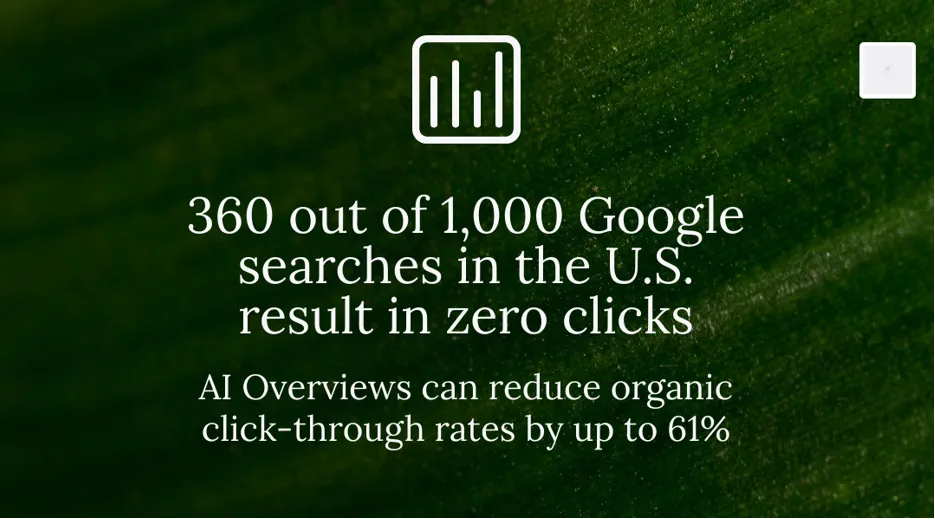
One of the most significant shifts impacting search visibility is the proliferation of zero-click searches and the rise of AI Answer Engines. Data from 2024 revealed that a significant majority of Google searches—approximately 360 out of every 1,000 in the U.S. and 374 in the EU—do not result in a click to an external website. This means users find their answers directly on the Google Search Engine Results Page (SERP), often within features like AI Overviews, featured snippets, or knowledge panels.
AI Overviews, which began expanding rapidly in late 2025, are particularly impactful. These AI-generated summaries directly answer user questions, drawing information from various web sources. While they can boost a brand’s visibility by citing its content, they simultaneously reduce the need for users to click through to the original source. Research indicates that AI Overview expansion can cut organic click-through rates (CTR) by as much as 61%. This creates a paradox: our content might be more visible than ever, appearing prominently in AI summaries, yet our organic traffic may decline. Marketers must adapt by focusing on being the authoritative source cited by these AI systems, ensuring our content is structured for easy extraction and attribution.
Core Differences Between Traditional SEO, GEO, and AEO
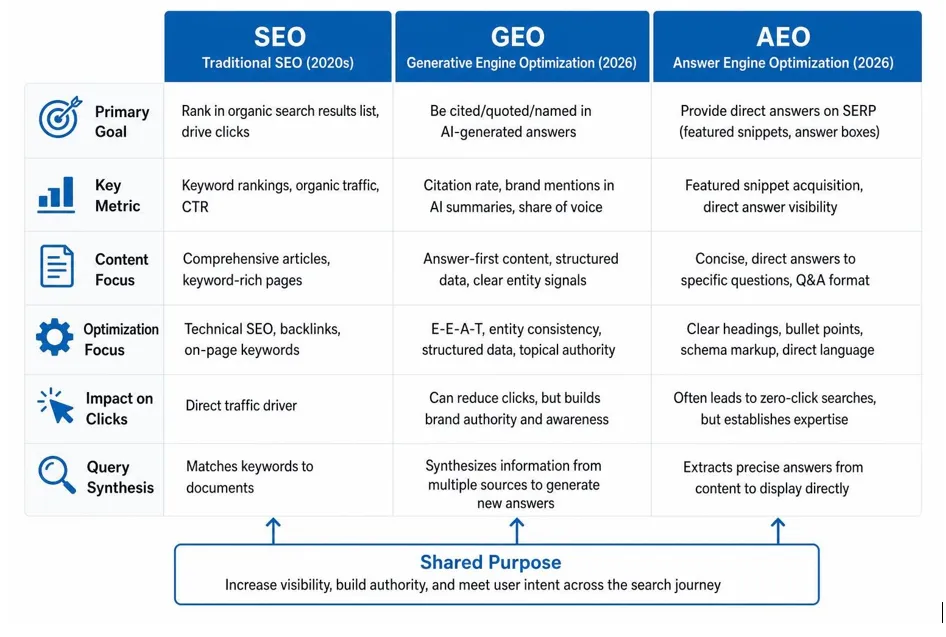
To effectively navigate this new landscape, it’s crucial to understand the distinct, yet interconnected, disciplines that contribute to overall search visibility.
Traditional SEO, the bedrock of digital marketing, focuses on optimizing websites to rank higher in organic search results lists. Its primary goal is to drive clicks to a website through improved keyword rankings, technical optimization, and content relevance.
Generative Engine Optimization (GEO) emerged as a response to the rise of generative AI. GEO specifically targets being cited, quoted, or named within AI-generated answers, such as those found in Google AI Overviews, ChatGPT, or Perplexity AI. The success metric here isn’t necessarily a click, but rather the “citation rate”—how often your brand or content is referenced as a source.
Answer Engine Optimization (AEO) is closely related and focuses on optimizing content to directly answer specific user questions. This often means structuring content for featured snippets, “People Also Ask” sections, and direct answer boxes. AEO content is designed to be concise, authoritative, and easily digestible, aiming to satisfy user intent directly on the SERP. Aspect Traditional SEO (2020s) Generative Engine Optimization (GEO) (2026) Answer Engine Optimization (AEO) (2026) Primary Goal Rank in organic search results list, drive clicks Be cited/quoted/named in AI-generated answers Provide direct answers on SERP (featured snippets, answer boxes) Key Metric Keyword rankings, organic traffic, CTR Citation rate, brand mentions in AI summaries, share of voice Featured snippet acquisition, direct answer visibility Content Focus Comprehensive articles, keyword-rich pages Answer-first content, structured data, clear entity signals Concise, direct answers to specific questions, Q&A format Optimization Technical SEO, backlinks, on-page keywords E-E-A-T, entity consistency, structured data, topical authority Clear headings, bullet points, schema markup, direct language Impact on Clicks Direct traffic driver Can reduce clicks, but builds brand authority and awareness Often leads to zero-click searches, but establishes expertise Query Synthesis Matches keywords to documents Synthesizes information from multiple sources to generate new answers Extracts precise answers from content to display directly
Multi-Surface Visibility and Entity-Driven Discovery
In 2026, true search visibility means extending our presence beyond Google’s traditional organic results. We must achieve “multi-surface visibility,” ensuring our brand appears across every platform where our audience searches, discovers, and makes decisions. This encompasses AI Overviews, ChatGPT, Perplexity AI, YouTube, TikTok, Reddit, Google Business Profile, and various AI chatbot platforms. The unifying factor across these diverse surfaces is often “entity authority”—how consistently and credibly our brand, products, or services are recognized and understood across the web. Building a strong digital footprint and maintaining consistent knowledge graphs are crucial for this cross-platform discovery.
Structuring Content for Multi-Platform Presence
To achieve multi-surface visibility, our content strategy must evolve. The traditional approach of creating a single blog post for a keyword is no longer sufficient. Instead, we embrace topic clusters, where a central “pillar page” covers a broad subject, and numerous supporting articles delve into specific sub-topics. This structure not only signals topical authority to search engines but also provides a rich reservoir of content for “content atomization.”
Content atomization involves breaking down pillar content into smaller, platform-specific formats. A comprehensive guide on a topic can be repurposed into:
- Short-form videos for TikTok and Instagram Reels.
- Detailed tutorials for YouTube search.
- Engaging discussions and Q&A threads for Reddit.
- Concise summaries for AI Overviews and chatbot responses.
- Infographics and visual assets for Pinterest and LinkedIn.
This strategic repurposing ensures that our message resonates across different platforms, catering to varied user preferences and search behaviors. By creating a core content asset and then adapting it aggressively, we maximize our reach and reinforce our entity authority across the digital landscape.
Aligning Paid Media and Paid Discovery Signals
While organic strategies form the backbone of sustained visibility, aligning paid media efforts is critical for achieving true omnichannel visibility. Paid channels, such as paid search (PPC), native advertising, and social media ads, offer immediate reach and precise targeting that can complement and amplify organic efforts.
Retargeted ads, for instance, demonstrate exceptional effectiveness, boasting a 400% engagement rate over initial ads. This is primarily due to their ability to tailor messages based on users’ prior interactions and expressed interests, guiding them further down the conversion funnel. Integrating organic insights with paid campaigns allows us to identify high-intent keywords and topics that perform well organically and then scale their reach through targeted advertising.
Furthermore, leveraging advanced platforms that offer AI-native AdTech solutions can significantly enhance paid discovery. These solutions use AI to optimize ad placements, personalize messaging, and predict user behavior, ensuring that paid signals are delivered to the right audience at the right time. By strategically combining organic and paid approaches, we create a cohesive digital marketing strategy that captures attention across the entire discovery journey, from initial awareness to final conversion.
Architectural Pillars for Sustained Search Authority
Sustained search authority in 2026 relies on a robust architectural foundation. This includes ensuring crawl efficiency, maintaining precise indexation protocols, building inherent domain trust, and meticulously structuring our content architecture and site hierarchy. Without these fundamental pillars, even the most brilliant content may struggle to achieve the visibility it deserves. Think of it as the invisible infrastructure that supports all our front-facing digital marketing efforts.
Technical Foundations and Structured Data Implementation
Technical SEO remains a non-negotiable prerequisite for search visibility. Core Web Vitals (CWV), such as Largest Contentful Paint (LCP), Interaction to Next Paint (INP), and Cumulative Layout Shift (CLS), continue to act as critical gatekeepers. Our research shows that pages passing all three CWV thresholds are 1.8 times more likely to rank in the top three. Mobile rendering is equally vital, as search engines prioritize mobile-first indexing. Ensuring our websites are fast, responsive, and error-free is fundamental.
Beyond site speed and mobile friendliness, meticulous structured data implementation is paramount. While Google states no special markup is required for AI answers, accurate schema markup (e.g., Article, FAQPage, LocalBusiness) aids search engines and AI systems in disambiguating content and understanding its context. This improves the chances of rich results and, crucially, AI citations. Consistent and accurate schema helps search engines properly crawl and index our content, forming the basis of our digital presence.
Information Gain and E-E-A-T in Digital Marketing and Search Visibility
The quality and credibility of our content are more critical than ever. “Information gain” has emerged as a key metric, indicating how much new, valuable, and unique insight a piece of content provides. Our 2026 ranking factors study found that content information gain is 3.2 times more predictive of top-3 rankings than word count alone. This means original research, unique data, fresh perspectives, and deep dives are highly rewarded.
Complementing information gain is the E-E-A-T framework: Experience, Expertise, Authoritativeness, and Trustworthiness. Search engines and AI systems increasingly evaluate content based on these signals. Demonstrating first-hand experience, such as through case studies, original screenshots, or personal anecdotes, is now considered the biggest content differentiator. We must clearly establish author entities, showcase their credentials, and build topical authority through a consistent body of high-quality work. This not only builds trust with users but also signals to AI systems that our content is a reliable source for their generated answers.
Measurement Frameworks: Connecting Impressions to Revenue
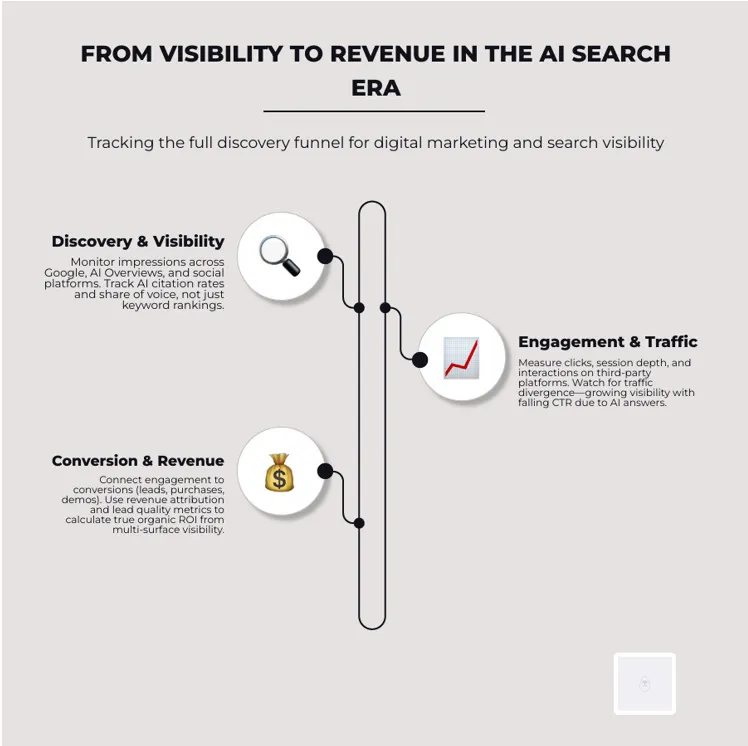
In the evolving landscape of digital marketing and search visibility, simply tracking rankings or organic traffic is no longer sufficient. We need comprehensive measurement frameworks that connect impressions, citations, and engagement across all surfaces directly to revenue. This requires sophisticated revenue attribution models, precise conversion tracking, and a holistic analytics setup that captures the full user journey. The ultimate goal is to understand the true organic ROI and the quality of leads generated through our search visibility efforts.
Tracking Metrics Across the Full Discovery Funnel
To accurately assess the impact of our multi-surface visibility strategies, we must track a hierarchy of metrics across the entire discovery funnel:
- Visibility: Impressions across Google, AI Overviews, social platforms, and other discovery engines. This includes organic keyword rankings (though their direct traffic impact may be diminished) and AI citation rates.
- Engagement: Clicks to our website (where applicable), session depth, time on page, and interactions with our content on third-party platforms (e.g., video views, shares, comments).
- Conversion: Form submissions, bookings, purchases, demo requests, and other defined conversion goals.
- Quality: The quality of leads and customers acquired through organic channels, measured by factors like customer lifetime value or sales qualified leads.
- Compounding Signals: Growth in branded search volume, assisted conversions, and overall brand mentions across the web.
Tools like Google Search Console provide invaluable data on impressions and organic performance, while Google Analytics 4 (GA4) allows for cross-platform tracking and the identification of AI channel referrals. Regularly monitoring these KPIs helps us understand where attention is being captured and how it translates into tangible business outcomes.
Managing Traffic Divergence in Digital Marketing and Search Visibility
The most significant challenge in measurement is managing the “traffic divergence”—the growing gap between rising search visibility (impressions) and declining organic click-through rates. Our data from June 2025 to May 2026 showed a 50% increase in the visibility and impressions index, while organic traffic fell by 25% during the same period. This paradox necessitates a shift in how we report and forecast.
Marketers must adjust traffic forecasts to account for a declining CTR factor, reflecting the impact of AI answer platforms. We should prioritize reporting both visibility and traffic to provide a complete performance picture to stakeholders. Branded search volume, in particular, has become a vital off-page signal, correlating strongly with overall organic traffic and indicating brand demand. Presenting this divergence as a structural change in the search landscape, rather than a performance failure, is crucial for executive reporting and maintaining support for SEO investments.
Frequently Asked Questions About Modern Search Optimization
How has generative AI shifted search visibility benchmarks?
Generative AI, particularly through AI Overviews, has dramatically shifted benchmarks. We now see significant impression growth as our content is cited in AI summaries, but often accompanied by a decline in direct organic click-through rates. The focus has moved from solely driving clicks to achieving “citation models,” where being referenced by AI systems is a primary goal, requiring new referral tracking methods to measure this form of visibility.
What is the distinction between SEO, GEO, and AEO?
SEO, or Search Engine Optimization, focuses on improving rankings in traditional search results lists, aiming for clicks to a website through index retrieval. GEO, Generative Engine Optimization, targets being cited or quoted by AI-generated answers, relying on generative synthesis. AEO, Answer Engine Optimization, aims for direct answers on the SERP (like featured snippets) by structuring content for immediate consumption and entity mapping. All three are crucial for comprehensive visibility.
Why is brand search volume a vital off-page signal?
Brand search volume is a powerful indicator of brand demand and entity strength. A high volume of direct searches for your brand name or products signals to search engines that your brand is recognized and authoritative. This contributes to algorithmic trust, improves overall organic performance, and correlates strongly with organic traffic. It’s a clear sign of a successful holistic marketing strategy driving real-world interest.
Conclusion
The digital marketing landscape of October 2026 demands strategic adaptability. The era of simply chasing #1 rankings is behind us. Today, success hinges on achieving comprehensive, multi-surface visibility, driven by a deep understanding of user intent and the nuances of AI-powered discovery. By embracing entity optimization, structuring content for diverse platforms, and integrating organic with paid strategies, we can build a holistic marketing framework. This approach not only ensures long-term authority but also translates attention into measurable revenue growth, securing our place in the future of digital marketing.

Ava Mitchell turns celebrity facts into smart, scroll-worthy stories at Star Ledger Pro, backed by 3 years of experience.


